
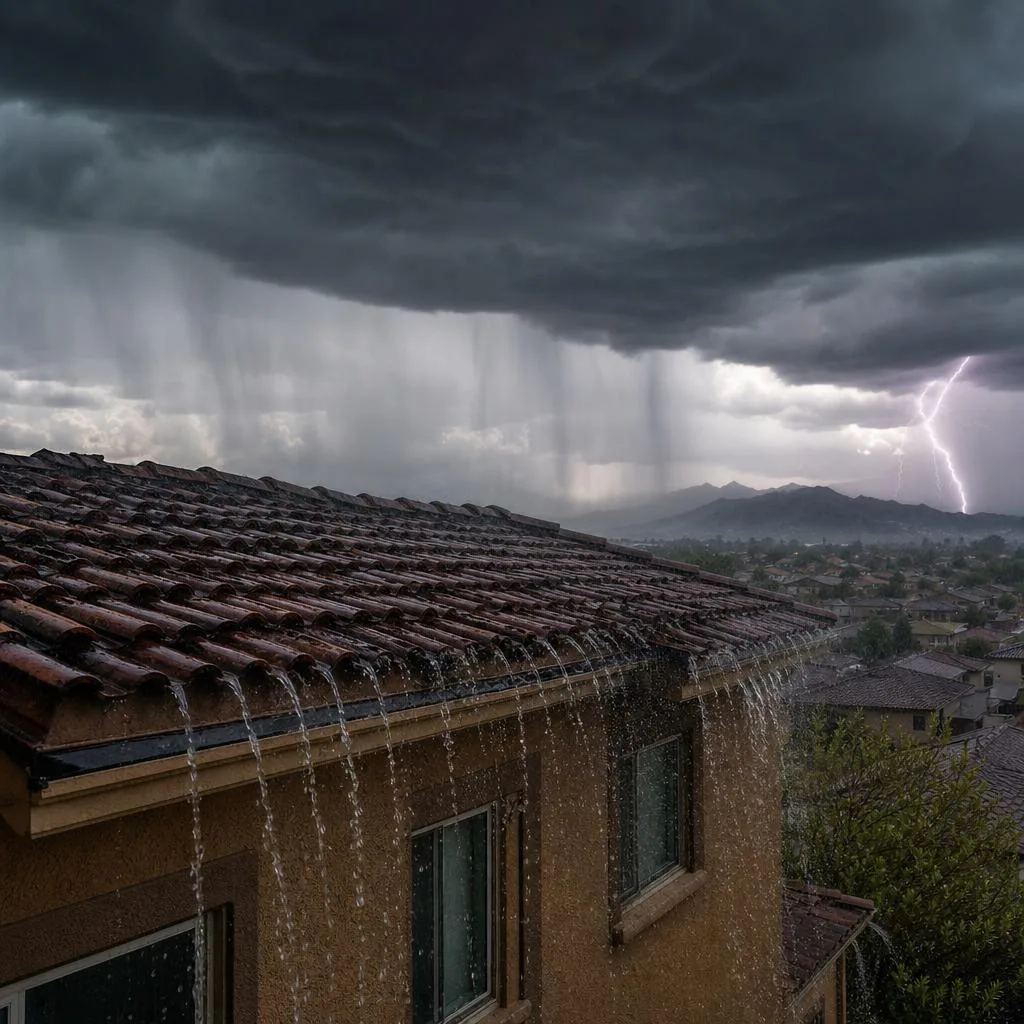
Monsoon season runs through the hottest part of the Arizona year, and it is when roofs in this valley reveal what has been quietly happening to them for the previous decade. A roof that has been fine for three hundred days will find its limit in twenty minutes of outflow wind and driving rain. This is organized as a timeline, because what you should do depends entirely on where you are in it.
Before the Season: The Cheapest Roof Work You Will Ever Do
Everything on this list is a small job in April and an emergency in August. Clear your valleys, scuppers and drains - dust, gravel, palm debris and blown litter accumulate constantly here, and blocked drainage is how water backs up under roofing material instead of running off it. Have the pipe boots checked - the rubber collars sealing your plumbing vents degrade under Arizona ultraviolet far faster than the roof does, and deteriorated boots are one of the most common leak sources in the Valley. Have shifted or cracked tile reset - a single broken tile exposes underlayment to direct sun and driving rain. Have the flashings looked at, particularly where the roof meets a wall, a chimney or a parapet - flashing is where most leaks originate. If you have flat or low slope sections, check the coating and the drainage - blocked scuppers on a flat or foam roof are the fastest way to end up with standing water after a storm. If it has been several years since anyone was on your roof, a pre season inspection is the highest return roofing decision available to you. We do them free.
During the Storm: What Is Actually Happening Up There
Two forces do the damage, and they are different. Wind is the first. Monsoon outflow arrives fast and can gust hard, and it lifts and shifts tile and breaks the seal strips on shingles. On tile, a lifted or shifted piece exposes the underlayment directly. On shingle, a broken seal means the next gust can take the shingle entirely. Driving rain is the second, and it behaves in a way ordinary rain does not. Wind driven water gets pushed sideways and even uphill, under tile courses and behind flashings, reaching places that are simply never wet during a normal rain. A roof detail that works perfectly in a gentle rain can fail completely under a monsoon. That combination is why a roof can pass a decade of light winter rain and then leak the first time a real cell moves through.
Water Is Coming In Right Now
Do these things, roughly in this order. Move what you can out from under it, and put a container down - water on a floor is cheaper than water in furniture. If the ceiling is bulging with trapped water, that is a load and it will eventually come down on its own - puncturing it deliberately in one controlled spot, with a bucket underneath, is generally better than letting it fail unpredictably, though use your own judgment about the drywall and anything electrical nearby. Kill power to the affected area if water is anywhere near lights or outlets. Photograph everything - if this becomes an insurance conversation, the documentation you take in the moment is worth more than anything reconstructed later. Do not go up on a wet roof in a storm - tile and coated flat roofs are extremely slick wet, and people are seriously injured doing this every year in the Valley. Call us at (480) 258-0925. We run 24 hour emergency roof repair and tarping across the Valley. The priority is stabilizing the roof and stopping the water, then doing the permanent repair properly once conditions allow.
Why the Tarp Matters More Than It Looks
It is tempting to wait until morning, or until the weather clears, or until you have gotten three quotes. Here is the arithmetic against that. Interior water damage compounds. Drywall saturates and has to be cut out. Insulation gets wet, stops insulating, and stays wet inside a wall or attic where nothing dries. Framing takes damage. And in a valley where an attic runs extremely hot, wet organic material plus heat is exactly the condition mold needs. The remediation bill for that chain frequently exceeds the roof repair that would have prevented it, several times over. A tarp at midnight is the cheapest thing in the sequence.
Weeks Later: The Damage You Did Not See
This is the part homeowners miss, and it is the reason we push post storm inspections. Most monsoon roof damage is invisible from the ground. Tile that shifted half an inch looks normal from the driveway, and the same is true of a tile roof whose fasteners have loosened. A shingle whose seal broke looks identical to one whose seal is intact. A flashing that worked loose is not visible at all. So the storm passes, nothing appears wrong, and nobody calls anyone. Then the next cell comes through three weeks later, water finds the gap that was opened the first time, and now there is a leak that seems to have come from nowhere. If a significant storm has moved over your neighborhood, get the roof looked at even if it looks fine. Especially if it looks fine. That is true across the Valley and particularly in the more exposed areas like Anthem, Cave Creek and the northern edges where there is less development breaking up the wind.
A Word About Who Knocks on Your Door
After a significant storm, contractors work neighborhoods. Some are legitimate local companies. Some are out of state operations that follow weather across the country, do fast work, and are unreachable when a problem surfaces two years later. Verify the Arizona ROC license number of anyone who knocks, directly with the Registrar of Contractors rather than from a card. Do not sign anything on a doorstep. Get an independent inspection before committing to anything.