
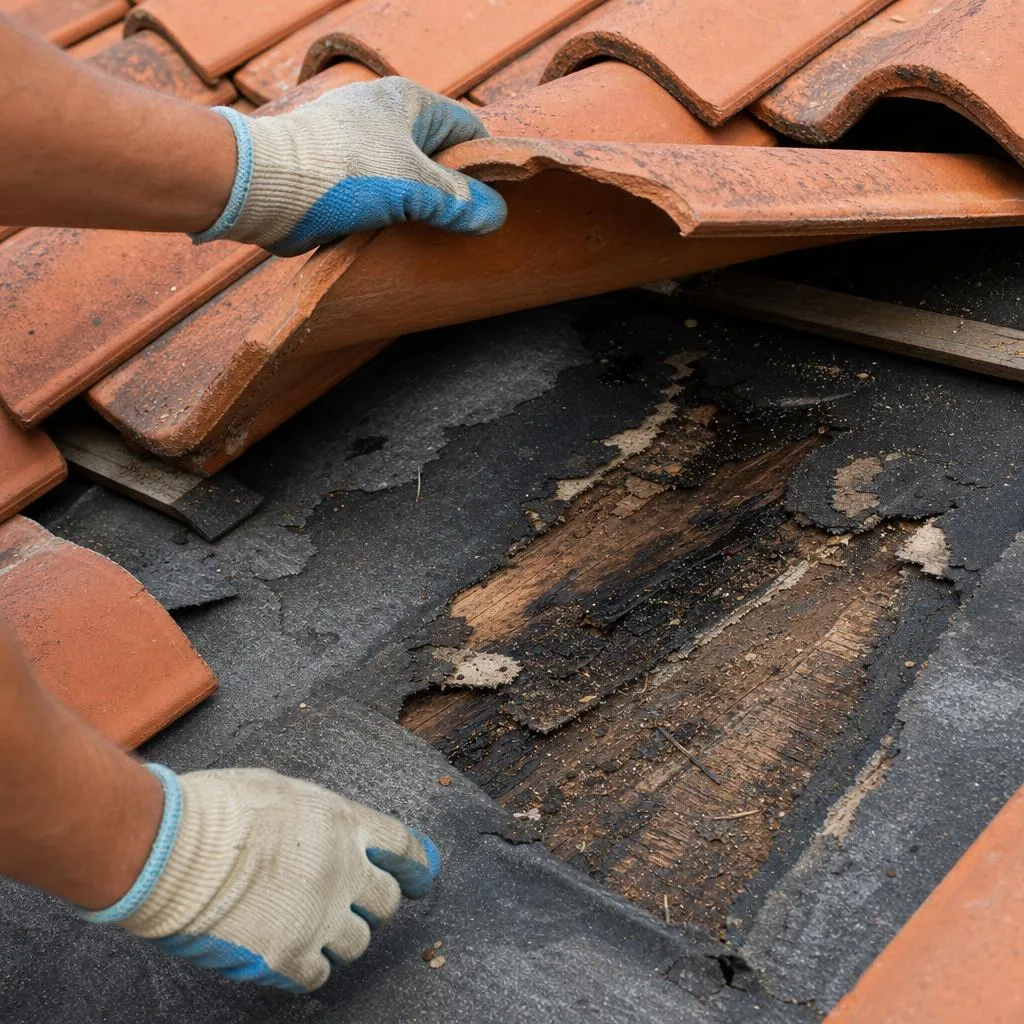
The most confusing thing about an Arizona tile roof is that it can be completely failed and look brand new. That is because the tile is not the waterproofing. The tile is a shield that takes the sun and the impact. The waterproof layer is the underlayment membrane beneath it, and in this climate heat is what kills it. It goes brittle, cracks, and stops sealing around the fasteners, while the concrete tile above it looks exactly as it did on the day it was installed. Here is what to actually watch for.
1. A Ceiling Stain With No Obvious Source
The classic sign, and the one people misread. Water enters through failed underlayment, runs along the roof deck or down a rafter, and drops through somewhere else entirely. The stain can be well away from the actual failure and in a different room. If you have a stain and your tile looks fine, that is not a contradiction. That is the normal presentation of failed underlayment.
2. The Roof Is 20 Years Old or More and Has Never Been Touched
This is less a symptom than arithmetic, and it is the most reliable indicator on the list. A great deal of Valley tile went down over basic underlayment carrying roughly a 10 year manufacturer warranty, which was the standard production builder specification. If that was installed in the nineties or early 2000s and nobody has been on the roof since, the product is now well past its warranted life, sitting under a deck that reaches extreme temperatures for a third of the year. It might still be holding. It is not going to keep holding.
3. Leaks in More Than One Place
One leak is a repair. A failed flashing, a deteriorated pipe boot, a cracked tile. Leaks appearing in several unrelated parts of the house are a system that has reached the end of its life. Patching individual entry points on a roof in that condition is money spent on something that needs replacing.
4. Debris and Granular Material in the Valleys or Gutters
When underlayment breaks down it does not vanish, it disintegrates. Finding small dark fragments or a gritty deposit collecting in valleys, at scuppers or in gutters can mean the membrane is physically deteriorating up there. Worth noting this is different from the granule loss you would see from a shingle roof, which is the mineral surface coming off the shingle itself.
5. Shifted, Slipped or Cracked Tile
Tile is fastened, and fasteners go through the underlayment. When the membrane around a fastener has gone brittle, its grip degrades, and tile starts to shift or slip out of alignment. So visibly misaligned tile is not only a tile problem. It is frequently a symptom of what is happening underneath, and each shifted piece exposes more underlayment directly to sun and driving rain, which accelerates everything.
6. Your Neighbors Are Getting Their Roofs Done
Not a joke. In subdivisions built within a few years of each other with comparable materials, roofs genuinely reach underlayment failure on a similar schedule. This is very pronounced in master planned communities like Anthem and in the nineties tile subdivisions across the north and west Valley. If several houses on your street have had roof work in the last couple of years, that is real information about yours.
7. A Previous Repair Did Not Hold
If somebody repaired a leak eighteen months ago and it is leaking again, either the repair was done badly or the repair was the wrong answer to the problem. Sealant applied over a failure, a tile set back down over a torn membrane, or roofing cement smeared on a pipe boot instead of replacing it will all buy a season. When the same area leaks again, the honest conclusion is usually that the underlayment in that region is done and no amount of patching addresses that.
What Happens Next
None of these are things you can confirm from the ground, and getting on a tile roof yourself is a genuinely bad idea. Tile is slippery, it cracks under foot traffic in ways that create new leaks, and people get hurt. What you do is get it inspected. If the underlayment has failed, the fix is usually a lift and reset rather than a full replacement. We remove and stack your existing tile, replace all the underlayment, repair any damaged deck, and reinstall the same tile with new fasteners. The roof looks unchanged and the waterproofing is new, and you did not pay for tile you did not need. Our inspections are free and come with photographs, so you see what we saw rather than taking our word for it.